Free
$0
5 cloud profiles · 10 wallets · 2 computers
- The Vflin core and the fingerprint tools
- Automation and schedules
- The local API, the CLI and MCP
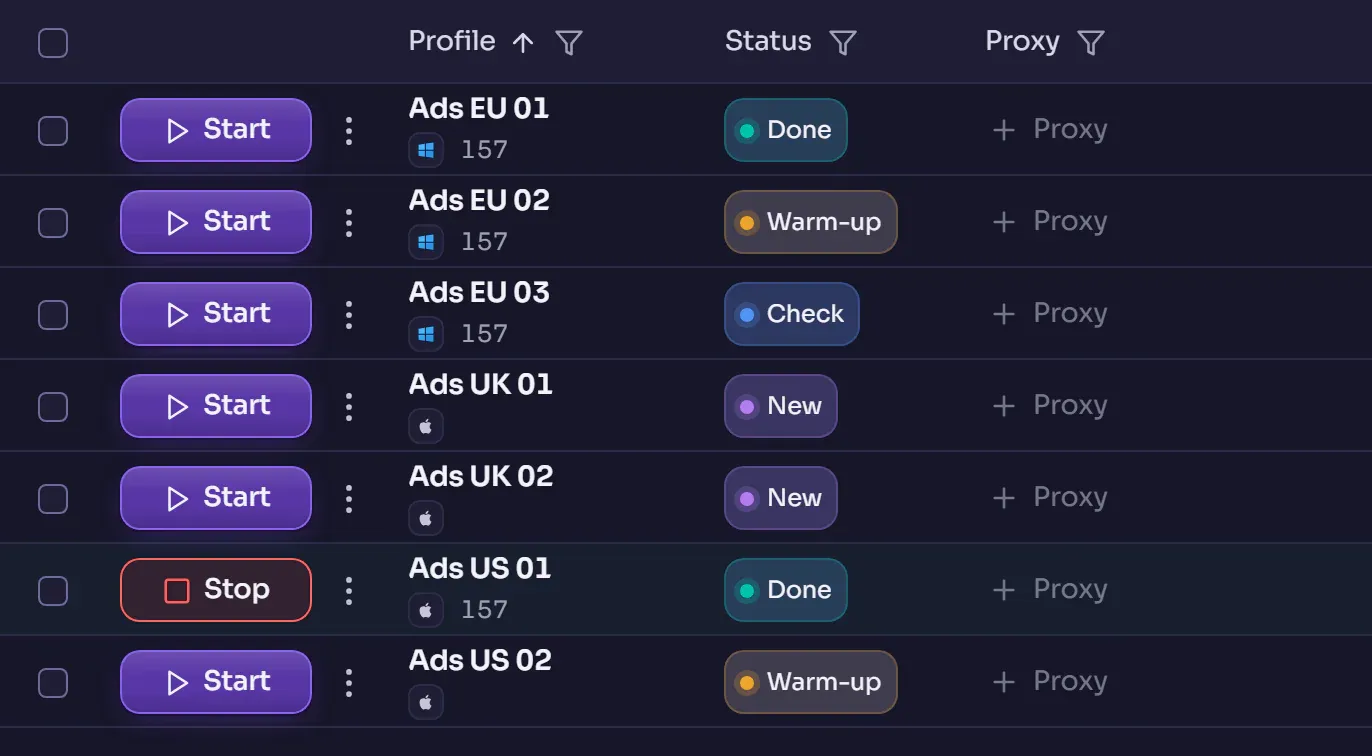
A frame taken from the running program on sample data: each profile shows its launch button, core version and status. One profile is running.
What a site sees
This is what this page has read in your browser. Nothing is sent anywhere: it is all computed on your side. Below — what detectors see on a Vflin profile.
22–31 October 2026 · the core the site serves
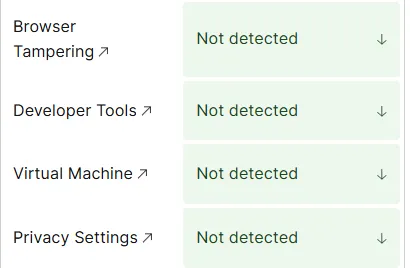
fingerprint.com · bot and tampering
Bot: Not detected
installed from the site · no proxy · 31 October 2026
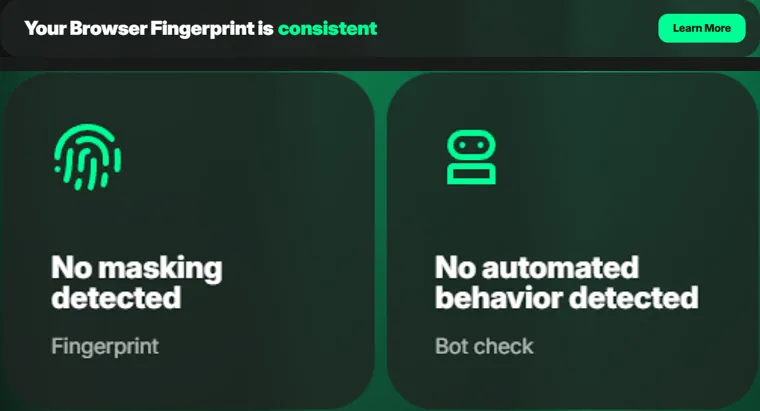
pixelscan · fingerprint check
Your Browser Fingerprint is consistent
installed from the site · no proxy · 31 October 2026
fingerprint.com · bot on the profile's exits
Bot: Not detected
22 October 2026
pixelscan · bot check
You're Definitely a Human
24 October 2026
WebRTC · your machine's address
machine address: 0
22 October 2026
02 · What it is strong at
your machine's address on the page 0
WebRTC and QUIC go through the profile's proxy or not at all — never around it.
Inside the profile is Chromium itself: TLS, HTTP/2 and QUIC are Chrome's.
The graphics card, screen, fonts and system are chosen together, as on a real computer.
Check it yourself on pixelscan and fingerprint.com.
A scenario on a whole folder and on a schedule, the cookie warm-up robot, the window synchronizer.
Puppeteer and Playwright connect to any profile; an MCP server is bundled.
A profile is encrypted on your computer — the cloud holds only ciphertext.
03 · The app
Frames of the running app on sample data — and each says what is strong in it.
Each profile's row shows the core version it lives on and its work status. A launch is one button, and the chosen profiles of a folder launch with one action.
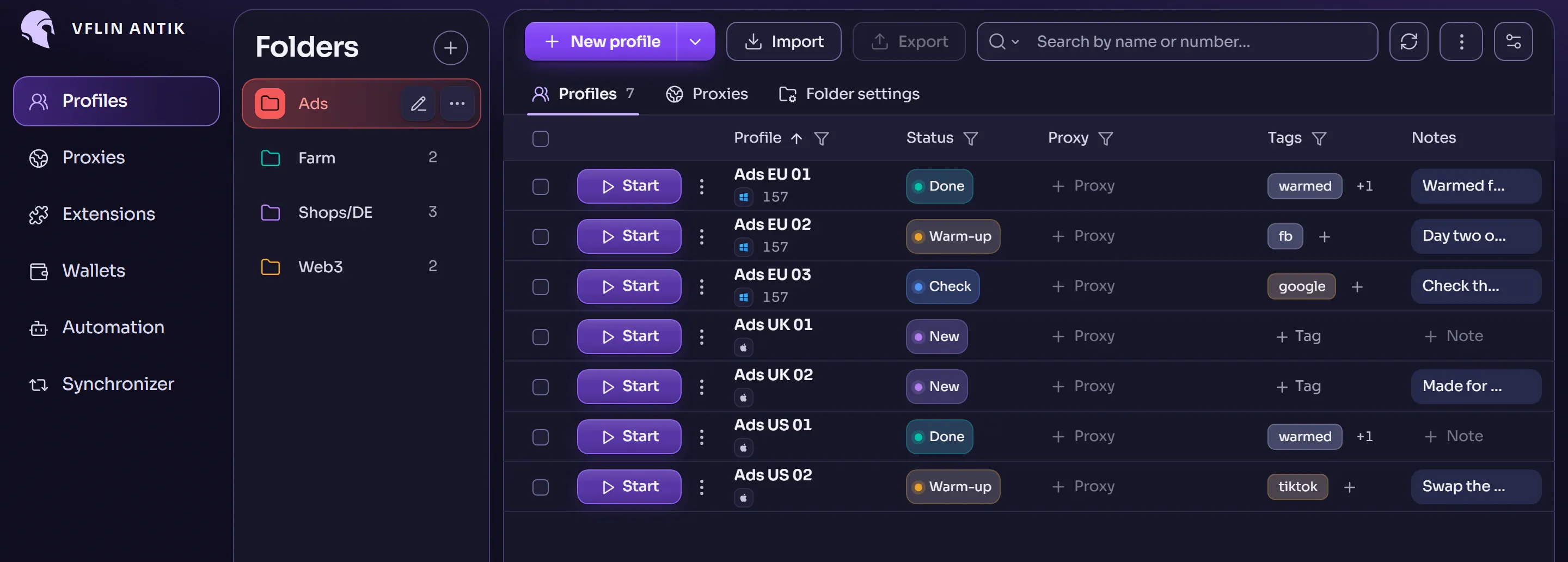
The core version is in every row: after a move to a new Chrome you see which profile has moved already. And before the move the app shows what will change — only the claimed version and what follows from it, as in a real Chrome update.
An exit is checked through the proxy itself: its country, time zone and the address's reputation are measured, not taken from the provider's label.
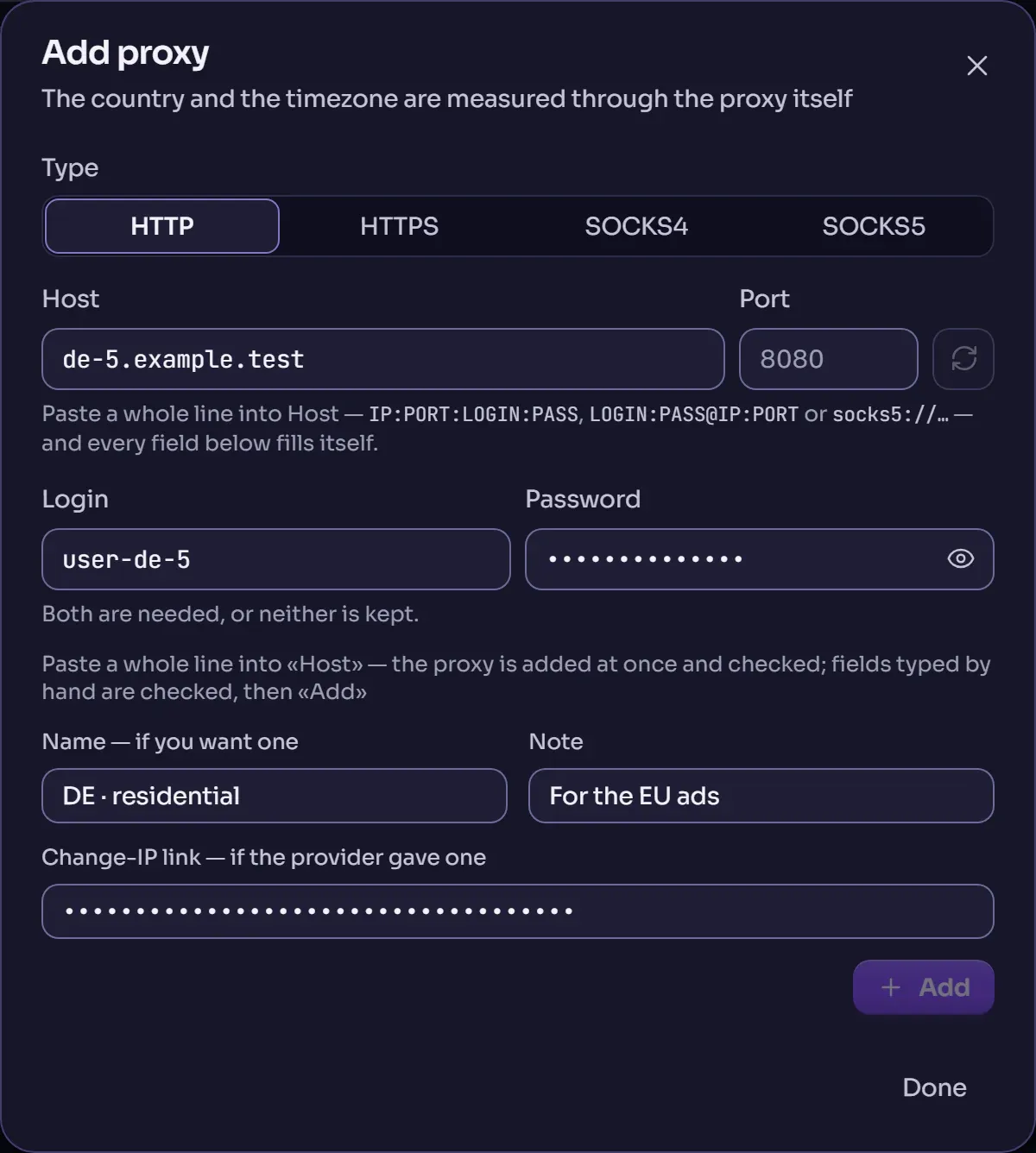
A provider's line can be pasted whole into the “Host” field — the fields fill themselves. The app reads an exit's reputation on a button, through the same proxy, at most three times an hour; if the site did not answer, it says “not checked”, not an invented zero.
A wallet goes into the list once and attaches to any profile. The app reads balances through the exit of the profile the wallet is attached to — not from your address.
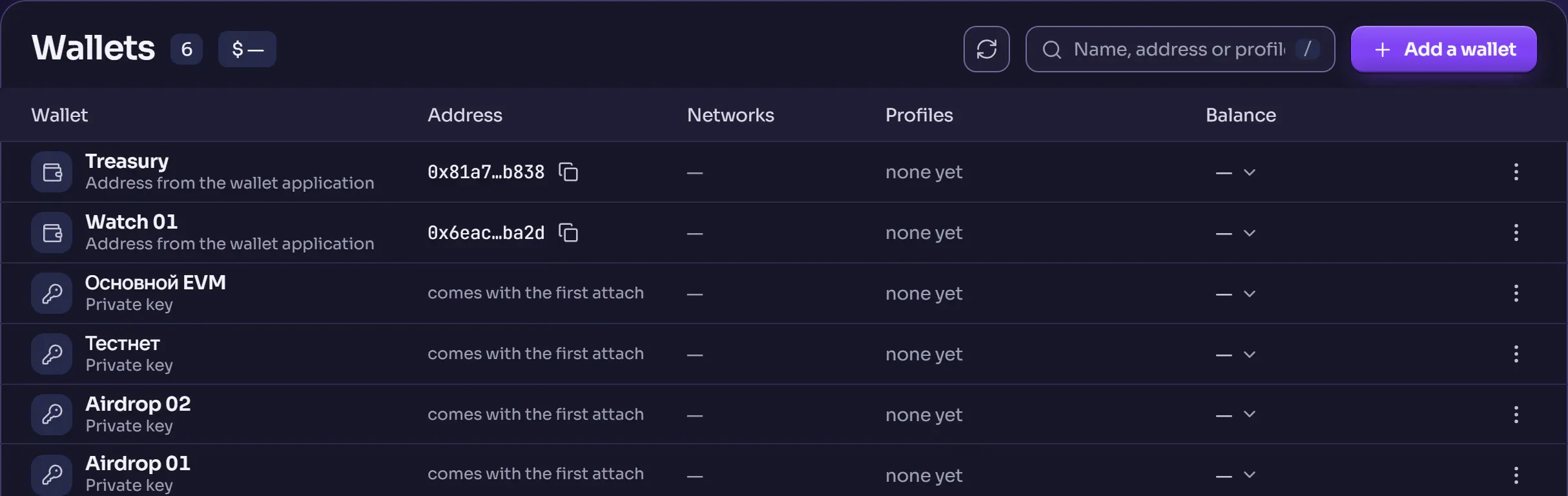
The key goes into the store on this computer: it never reaches the log, and the API never hands it back. A wallet attaches from the list or from the profile's form — Rabby opens with it already there.
04 · Pricing
Free includes 5 profiles and 10 wallets; past that, pick a plan — under the price you see what one profile costs.
Paid in cryptocurrency, month by month, in the account. Prices can change; you are charged what this page says on the day you pay.
Free
$0
5 cloud profiles · 10 wallets · 2 computers
Price
profiles
$15 / month
≈ $0.15 per profile a month
100 cloud profiles · 100 wallets · 10 computers
The core, automation, the API, the CLI and MCP are available on Free. Paid plans raise the limits and let you hand a profile to another account.
05 · Network
WebRTC usually gives away the machine's real address around the proxy. Here datagrams go through our own relay and the same exit as the pages. Pick a situation and make a call — you can see where every datagram goes.
example · addresses from documentation ranges
Press «Make a call» — or wait: the call starts by itself.
06 · What for
Every account gets a profile of its own: its own device, its own proxy, its own cookies. To a site they are different people on different computers.
Facebook, Google and TikTok ad accounts — each in a profile of its own, with its own proxy.
Every profile has a Rabby wallet of its own.
Stores on marketplaces and on their own sites — each with its own device and address.
Social accounts in folders, a profile each.
A profile with the device and the country you need — and the same profile tomorrow.
The names and marks belong to their owners. Vflin is not affiliated with them.
07 · Automation
The pointer drives a real mouse: it comes up to the button, stops, presses and lets go. Text is typed key by key, the page scrolls with the wheel. So menus open, fields see every key, and buttons fire. Run the scenario here — on one profile or on a whole folder.
example data · the scenario runs right in your browser
Script
Find a product and read its price
Popular
Press «Run» — or just wait: the scenario starts by itself.
The numbers in this demo are the program's own: the pointer's path, the pauses, the hold, the typing cadence and the wheel step come from the scenario engine. The shop, products and prices are an example.
08 · For developers
The local API answers on your computer over HTTP. It offers the same actions as the window: create a profile, launch it, hand it a scenario and read the result. The same methods are in the command line, and for AI agents there is MCP.
$ curl -X POST -H "Authorization: Bearer $TOKEN" http://127.0.0.1:$PORT/v1/profiles/$ID/start$ vflin profile start $ID› vflin_profile_start { "id": "$ID" }An example task
In the morning, on a schedule, open the twenty profiles of a folder, run one check in each and put the result into a table — with a scenario from the app or with five lines of your own code.
Documentation: Local API, CLI and MCP.
09 · The cloud
A profile is encrypted on your computer and goes to the cloud sealed. Someone with access to our server sees how many profiles you have and how large they are — but not their contents, cookies, fingerprint, proxy or password. This was checked by querying the database, not retold.
On its own Chromium build, and the app shows the version. The core is updated separately from the app — we carry our changes over to the fresh stable Chrome about once a month.
HTTP, HTTPS, SOCKS4 and SOCKS5, with a login and password. The password goes into encrypted storage and is never handed back — the registry only shows that it is set. WebRTC goes through the profile's exit; when the proxy cannot do UDP, the core answers with the exit's address itself.
Every open profile is a separate browser window, so how many you can have is limited by the computer's memory; we give no number of our own until we have measured it on different machines. It needs Windows 10 or 11, x64.
Yes: an export file or a list of profiles as text — Vflin creates profiles with their settings (user agent, screen, language, time zone). Cookies are loaded from a file into an open profile — merged or replacing the whole set.
A profile is handed to a team member together with the key that opens it, and access is revoked by changing the key. Roles, permissions and the action log live in the cloud part of the account.
No. A profile's contents are encrypted on your computer, only ciphertext goes to the cloud, and the server has no keys to it.
Rabby, for now. The key goes once to the program on your computer and is sealed into the profile; the API never hands it back.
There is a local HTTP API, a command line and MCP for agents. A profile can be opened with a CDP port — then Puppeteer or Playwright connect to it; by default the channel is closed and open only to the Vflin program.
The account returns to the free plan: 5 profiles stay working — you choose which — and the rest become read-only: they can be exported to a file, and a renewal brings everything back at once. If the plan is not renewed, the cloud copies of the extra profiles are deleted in time — a letter comes before that, and the copies on the computer stay.
Plans are monthly, paid in crypto, no card. A refund is made within 14 days of the payment, for the days still ahead, to the address you name. Prices are on the pricing page, the refund terms on the refunds page.
The installer is not signed with a certificate yet, so Windows shows a SmartScreen warning. The download page gives the file's size and checksum — compare them before installing.
A version for Windows 10 and 11, x64, is available now. Versions for macOS and Linux are not released yet.
Install Vflin, sign in — the free plan gives 5 cloud profiles — add a proxy and open a profile.
Download for Windows